How to Do Enterprise SEO
Hello Riddlers!
Today's newsletter sponsor is myself 😄 Check out the Python for SEO course and upskill yourself in 2026!
--——> Check out the course here <--------
I have been lucky in my career to work with a wide variety of clients of different sizes and in different industries, but even luckier to have worked on both sides of the fence, SEO agency side and in-house.
And one common thing I see in the SEO industry, a lot of the the tactics and recommendations circulating are either for people that worked purely agency side, or have not experienced actual enterprise level websites.
What is Enterprise SEO?
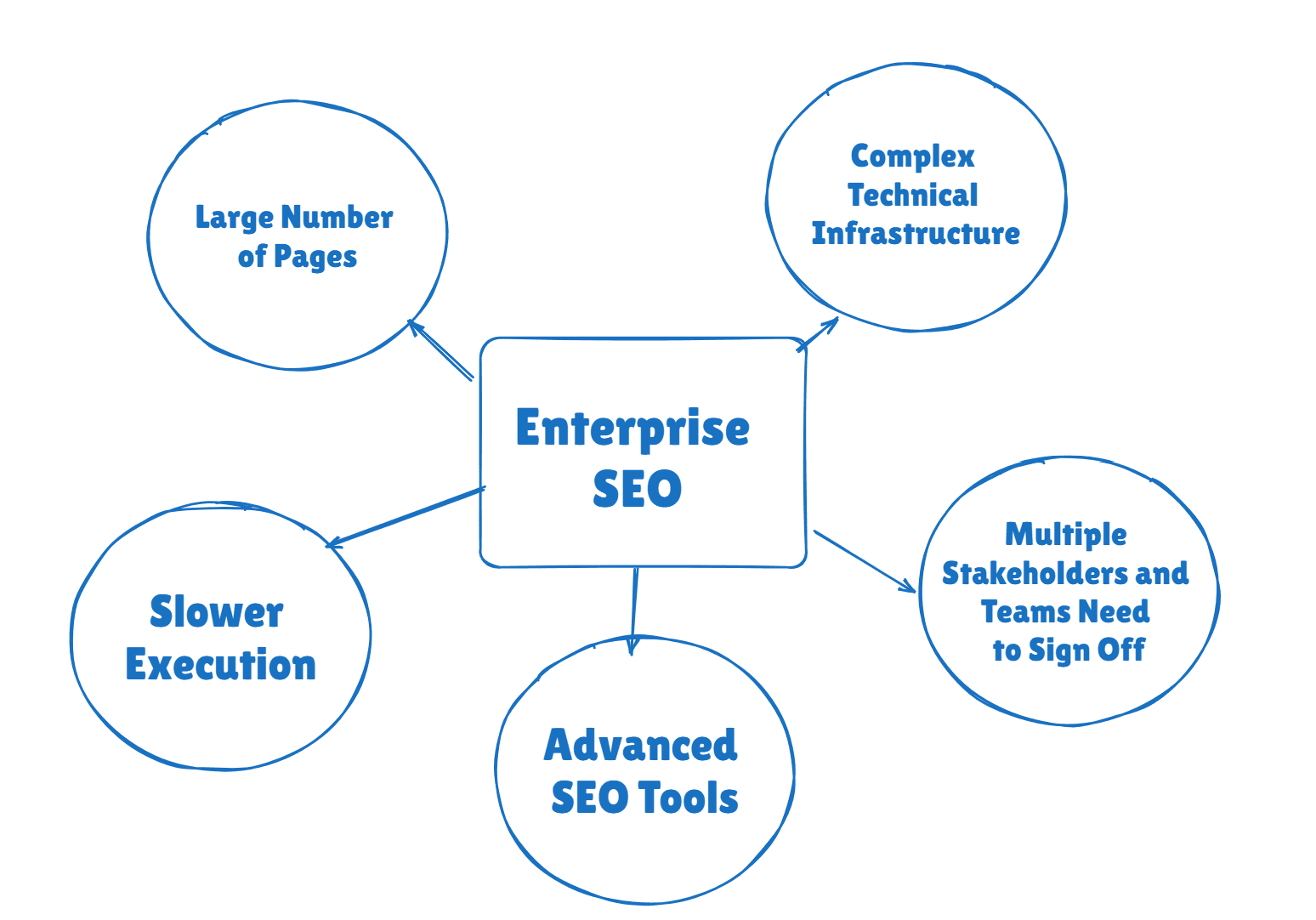
Enterprise SEO is a large-scale strategic approach to optimize websites with thousands to millions of pages for search. It involves tackling of complex technical infrastructure and content at scale. Additionally enterprise SEO requires cross-functional collaboration and usually advanced SEO tools.
What is the difference between enterprise SEO and traditional SEO?
The main difference between enterprise SEO and traditional SEO is scale and complexity. Enterprise SEO focuses on optimizing large websites with thousands to millions of pages, complex site architectures, and multiple stakeholders. Traditional SEO targets smaller sites, fewer pages, and simpler optimization workflows with faster implementation.
What the experts say
I spoke with several SEOs who have worked on websites at that scale to hear how they describe enterprise SEO. This is important, because enterprise SEO is often time treated as just usual SEO by many in the community, while there's a distinction!
Jean-Christophe Chouinard: "When working on very large websites, forget crawling your website. Work with actual data points that you have available such as server logs and Google Bulk Data export. Understand page templates and gather aggregate insights, instead of page level insights. Find out if you can understand how Google cluster content, and which sites sections behave similarly in search. In a well optimized website, on aggregate, similar pages should see their traffic patterns correlate, if they do, then you have a great set-up to run SEO experiments"
Greg Bernhardt: "The most important thing you can do with large enterprise sites with hundreds of thousands or millions of URLs is to develop/maintain a comprehensive segmentation framework. You can do this via scrappy URL context or develop classification tags assisted by LLM. This allows you to confidently analyze sections of your site across any number of attributes to find insights. My everyday tech stack is Cursor, Google Colab, BigQuery, DBT/Airflow and a number of APIs."
Mihir Naik: "In enterprise SEO, success isn’t just about identifying what’s wrong. The real challenge is understanding how issues actually get fixed within a large organization: how data flows across teams, who owns what, the engineering effort involved, and the trade-offs required. Strong enterprise SEOs focus heavily on prioritization, stakeholder alignment, and execution planning - building allies across product, engineering, and content teams, and creating a realistic roadmap that balances impact vs. effort.
From a tooling perspective, large and complex sites typically need a mix of enterprise-grade crawling and monitoring tools, log file analysis, Google Search Console at scale, and custom internal dashboards to connect SEO data with product and business metrics. The exact stack depends on site size and complexity, but the goal is always the same: visibility into what’s happening at scale and the ability to translate SEO insights into actions teams can actually implement."
- "Remove any potential visibility or indexing blockers. Don’t just "set and forget." Always check your wing mirrors on your money pages especially. Use log analysis to see which money pages crawlers visit most often and keep these pages fresh to signal relevance. Also, audit your "Discovered - currently not indexed" report. Fixing any content, structural or technical blockers on those pages can boost visibility faster than writing a lot of new content. (Tools: Screaming Frog, Log Files, Google Search Console)
- Spot-Check Your Translated Content. Auto-translate is tempting for scale but can kill conversions when not reviewed. You don't need to check every page, but use heatmaps on your top non primary revenue pages. If users are dropping off or CVR is much lower vs other languages, it is often a bad translation or unclear copy eroding trust. A native speaker review on just those key pages pays for itself. Making sure your most important pages make sense to their readers can quickly improve both your traffic & CVR. (Tool: Hotjar, GA4, find native speakers).
- Adapt Reporting & Strategy for AI. You don’t need a totally separate strategy for AI as good seo essentials are still what’s most important, but you do need new metrics. Monitor your server logs to understand what the likes of ChatGPT are crawling on your website (also for ChatGPT it’s more important to focus on what the crawler ChatGPT-user is crawling rather than their training crawls). Track the user crawls, then track the "AI Referral Traffic" in GA4 to identify which pages are gaining clicks from AI and then track conversions from AI so you can understand a clear path where AI is successfully feeding AI answers that actually lead to sales. Crawls - Clicks - Conversions!! (Tools: Server Logs, GA4)
- Embed with Product & Tech. At the enterprise level, SEO cannot exist in a silo. Build business cases, submit clear formal tickets, and sit in on product roadmapping. When you treat SEO as a product requirement rather than a marketing add-on, you prevent technical debt or future clean up projects. It also creates a clear understanding between tech product and seo which could lead to your business next big idea or win! SEO is a team game and everyone wins when you learn how to communicate efficiently and consistently with the tech and product teams. (Tool: Your People Skills!)
- Get Comfortable with Offsite SEO. Organic is just as much offsite as onsite now in 2026, so don’t ignore it. Sync up with your Social, Digital PR, Brand, Paid & Affiliate teams. You will often find quick wins, halo opportunities (partnerships & backlinks) campaign insights, or opportunities to better align messaging across channels. You aligning the messaging on your top pages, new content with messaging every other team is putting out is much more impactful than everyone working in silos. Even if you’re the only seo in house - you should still operate as a team member with the wider business. Oh - and I’d recommend carrying out competitor benchmarks when you have the time. It’ll help you find content gaps, their strength/weaknesses and what works for them, it may inspire your next big idea"
Reading through these perspectives alone could have been enough to end the newsletter here today, but of course, I couldn’t resist adding my own take 😄
How to Do Enterprise SEO?
- It's almost never worth it to focus on individual page optimizations, as websites get bigger your focus shifts to page templates and content folders. So the first thing I would do is identify the type of pages/templates we have on the website for reporting and for auditing purposes.
- Audit page types. So instead of auditing each product page or blog page on your website, you can audit a few of each type and make recommendations based on that. Because at the enterprise-level, a change in one template, will cause changes in all other similar pages. Which also mean you need to be extra careful.
- Reporting is a whole other challenge altogether. Your report will develop and improve as you understand the business, the market and the website better. Report on categories and the way different business units and stakeholders manage the website. For example, in some instances, I had different teams run different parts of the website, this means for each of those website sections, you need an individual report. In addition to segmenting your report by how you see fit from an enterprise SEO standpoint. So something to keep in mind.
- Fixing indexability issues is a major win, large websites often struggle with crawl budget and crawl efficiency, and more often than not, end up with thousands, if not millions of pages that are pending indexation in GSC. So fixing an indexing issue, can produce an exponential output due to the number of pages it can impact.
- Slow and steady wins the race. The larger the website and organization, the slower and more challenging you will be able to make changes... the biggest lesson I learned is... "have patience"... you cannot expect devs working on a website like Amazon for example to make changes at the same pace and ease as devs working on a small shopify website 😄
- An essential enterprise SEO skill is being able to get buy-in and talk to stakeholders. You see, teams already have tons of work lined up for them, in addition to tons of existing technical debt, why should they prioritize SEO? from their standpoint, if there's a technical debt anyways, it might as well be SEO 😄
- Technical issues may have a bigger impact than fixing them on small websites. But that also means that technical audits are not a one and done task, they take a lot of time and consideration.
- Tools... your traditional tools may stand helpless against a website with millions of pages. This is where you need to be smart, if you can get cloud-based enterprise SEO tools that's great, but if not, you can still workaround the situation by breaking down the pages into smaller clusters and audit/monitor them.
- Flexibility. This is the keyword for being a good enterprise SEO. You need to be able to offer different solutions technical or otherwise to the same issue. If devs cannot execute on one recommendation, work with them to find an alternative.
And That’s a Wrap (Almost 😄)
As you can see, enterprise SEO requires approaching large websites with a different mindset—one that demands flexibility and patience. It’s challenging, but honestly, it’s also a lot of fun.
another thing to always keep in mind, not all SEOs have worked on this category of websites, advice may not always be relevant. I hope you found this blog relevant though😀
That's that for today folks and see you next newsletter!
Support the Riddler!
- Sign up for my newsletter if you're not already.
- Share the newsletter and invite your friends to signup. Help me reach 2k signups by end of 2025 please 🙂
- Provide feedback on how I can make this newsletter better!!!
- Buy me coffee.
- If you're an SEO tool or an SEO service provider, consider sponsoring my newsletter. I'm also open to other partnership ideas as well.
Disclaimer: LLMs were used to assist in wording and phrasing this blog.
The SEO Riddler Newsletter
Join the newsletter to receive the latest updates in your inbox.