
URL Structure for SEO

Hello Riddlers!
Today's newsletter sponsor is myself 😄 The course is on sale for 25% till Dec 31 2025! Just use this Coupon Code: BLACK2025
--——> Check out the course here <--------
There are a bunch of standard SEO practices that are kinda agreed upon when it comes to optimizations for URLs, and I'm not about to change that. What I disagree with is how often those practices are treated as high-impact levers, regardless of context.
For example, changing entire website URL structure just for the sake of SEO is not something I would ever recommend to clients, unless under very specific conditions.
In today's blog, I’ll briefly cover the standard URL best practices, then focus on the part we don’t talk about enough: impact versus effort of those best practices, and how sometimes doing nothing is totally fine!
Best SEO Practices for URLs
Without further ado, here's a short to the point list of what you probably already know, and we agree on.
URLs should be short and descriptive.
URLs should include keywords.
Avoid repetition or keyword stuffing.
URLs should be lower case and should include hyphens "-" and not underscores "_".
Remove stop words like "a", "an", etc....
URLs should have a a clear, logical hierarchy.
That's really about it, I'm sure some people can throw in few things here and there like https for example, but that list above is the core recommendations for a good URL from an SEO perspective.
Myths and Misconceptions
This is why I am writing this blog, here are few things that are often overlooked when discussing or sharing recommendations to optimize URLs.
1# Google DOES NOT use URLs structure to understand the website structure.
You read that right.... Google DOES NOT use URL structure to work out the website structure. This fact is buried in Google documentations, and your few first searches may not return this information.

Why does this matter? Because I’ve lost count of how many times I’ve heard SEOs recommend a full URL restructure purely to "help Google understand the site better". Do not do this, because simply, the impact vs the effort math isn't gonna math... this is technically a migration for... not so much in return 😄

You know when you can do this safely without any concerns? if you have a very small website, or your website is still new, then ya for the sake of having logical URLs you can do that, but otherwise, I'd stir away.
I’ve seen this play out in practice, too. For example, in my commentary on DMarge’s traffic decline, one of the changes they tested was a URL structure update. The result? No meaningful impact.
2# It's OKEY to have a flat website URL structure
Let me say this loud and clear, it's ok to have URLs in the form of:
[domain-name.com]/[blog-title]
[domain-name.com]/blog/[blog-title]
[domain-name.com]/products/[product-title]
You see in the examples above I don't have a blog category or a product category listed? To tell you the truth, I worked with some of the most broken URL structures in the past, that we couldn't just change because the website was large and custom made CMS, where every change will need to be hard-coded, and every thing went just fine... we were doing great in search.
URLs aren’t the bottleneck.... They rarely are.
To be clear, I’m not advocating for flat URLs when you have the option to implement a logical hierarchy. What I am saying is that making URL changes at scale rarely delivers the impact people expect.
This takes us to the next point:
3# Categories in URLs: when do they matter?
There are three situations that I would change the URLs to include the category and avoid a flat structure:
It's a brand new website or a small website. Because remember, changing all the URLs structures IS A MIGRATION, which always comes with risks and maybe a period of performance fluctuation.
If your website is getting penalized because there's a specific type of content that should not be on your website, not having folders or categories in your URL can cause your entire website including subdomains to be penalized.
Google served forbes.com/advisor/ folder a manual action back in November for site reputation abuse. Yes, the folder only, not the entire website.
Google penalized Geeks for Geeks ENTIRE website. You know why? the problematic content was not isolated in a specific folder or subdomain, and therefore Google had to penalize the entire website.
International Sites. If you're doing international SEO and your website have multiple languages, having a clear folder structure in the URL that separates one language version from the other is a requirement, not just a best practice.
4# Don't change URLs just to add keywords
While this may come off a bit controversial, it does fall under unnecessary, not so useful SEO changes. Yes, you should have keywords in your URLs, but what if they URLs are already live, getting impressions from search and clicks, and you want to further optimize the pages, should you change the URLs?
Short answer is no, it is rarely the case.
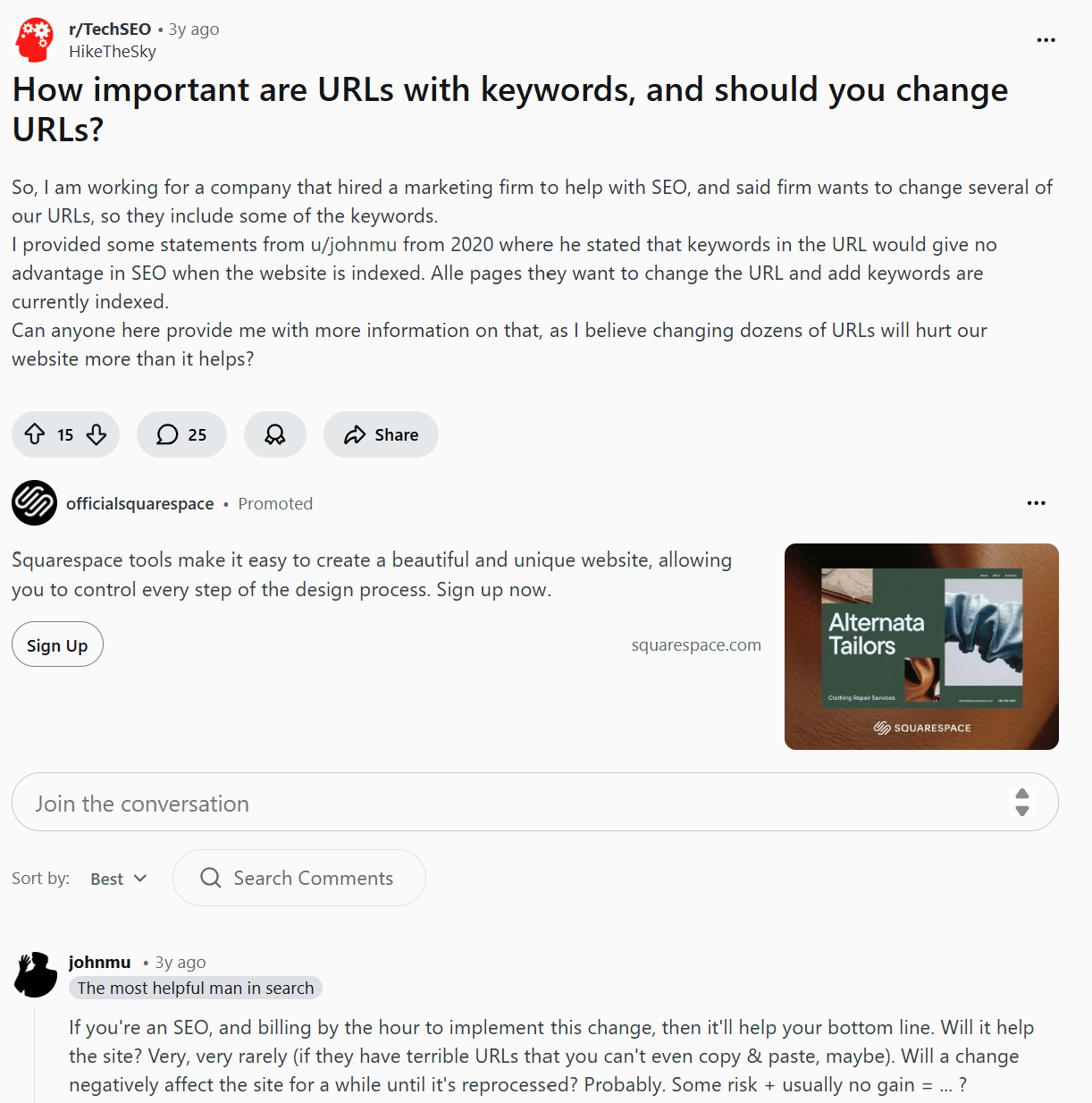
Here's what John Muller said on Reddit when asked about changing URLs to include keywords:
"If you're an SEO, and billing by the hour to implement this change, then it'll help your bottom line. Will it help the site? Very, very rarely (if they have terrible URLs that you can't even copy & paste, maybe). Will a change negatively affect the site for a while until it's reprocessed? Probably. Some risk + usually no gain = ... ?"
And That’s a Wrap (Almost 😄)
Just because something is a best practice, does not mean you should execute on it. As I always say, we are very obsessed with checklists in SEO, that we often forget the big picture and what we're trying to accomplish.
Optimizing URLs falls under the category of it depends, is the change worth it really?
That's that for today folks and see you next newsletter!
Support the SEO Riddler!
Sign up for my newsletter if you're not already.
Share the newsletter and invite your friends to signup. Help me reach 2k signups by end of 2025 please 🙂
Provide feedback on how I can make this newsletter better!!!
If you're an SEO tool or an SEO service provider, consider sponsoring my newsletter. I'm also open to other partnership ideas as well.
Disclaimer: LLMs were used to assist in wording and phrasing this blog.